On Design and Time
How can we make sense of the concepts of design and time, which cannot be examined or discussed independently of one another, on the basis of the relationship they establish with each other? If we consider the human being in light of the fact that we exist in time, together with what we produce within this movement through time, we can begin to address this question. Contemporary art and architecture, which will form another basis of the discussion, also come to the fore as subjects that must be examined within the design-time relationship, both technically and theoretically.
First of all, what is our relationship with time as beings conscious of its flow? The individual who asks what it means to exist (Dasein)* is also aware of passing time and capable of questioning it. Our relationship with time affects our existence more profoundly than other concepts and metaphysical elements. The individual existing in time has experiences; through these experiences, intuition is triggered and perception is formed. The perceiving individual is also a creator. The way in which the abilities acquired through personal experience are used is likewise related to time.
If we examine the design that emerges through the use of these abilities in two different ways, the first is to attribute a temporal meaning to the product through the relationship it establishes with the individual; the second is the production process of the work created by the individual.
At precisely this point, contemporary art and architecture become particularly important. Conceptually, contemporary itself carries a temporal meaning, yet this meaning does not refer to a sharply defined period of time. Although it may simply be understood as the body of works produced in the same age, existing and producing within time resists and opposes the present.** These effects directly influence both the design process and the relationships among material, form, and space in artistic and architectural production. Juhani Pallasmaa, for example, speaks of the blandness offered by technology in material selection and of the way synthetic materials fail to embody processes of aging. According to him, all matter exists within the continuity of time; the patina of wear adds the enriching experience of time to building materials.*** The relationship a design product establishes with time directly affects the individual and their experiences. At the same time, design itself is also affected by this relationship.
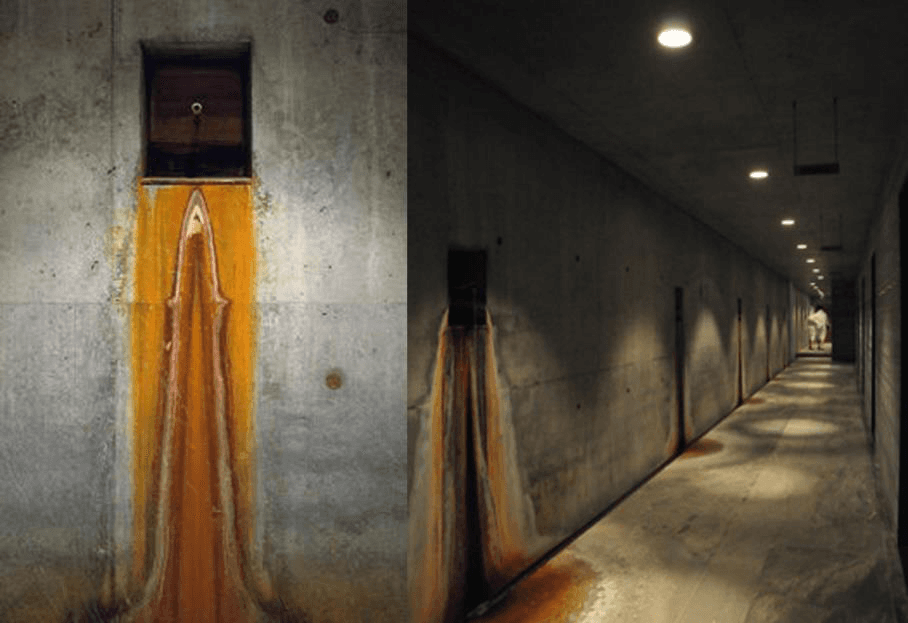
The Therme Vals - Peter Zumthor
The image formed by the integration of fair-faced concrete walls and slabs with water flowing through holes that rust over time appears at The Therme Vals as one of the clearest examples of the patina of wear. The material is situated within a temporal process together with the design narrative.
Another powerful example that keeps alive the temporality of design, or its relationship with time, is found in Picasso's paintings. The fundamental element that comes to the fore in Picasso's work is the bringing together of different viewpoints directed at an object on the same plane. What is often overlooked, however, is that these different viewpoints also define different moments or intervals of time. An object perceived in two dimensions is thus made to exist through time.
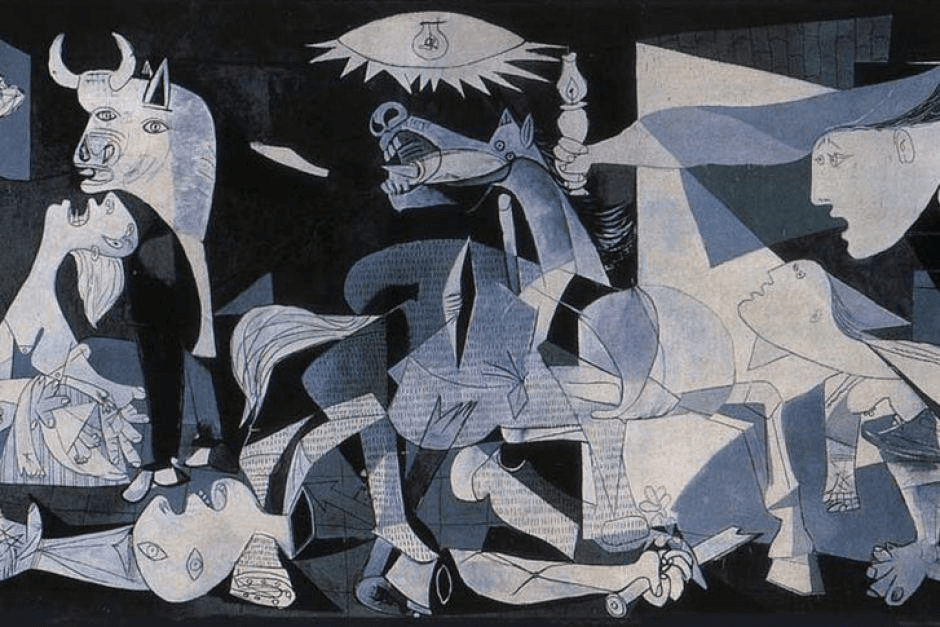
Guernica - Pablo Picasso
How, then, can the production process of the work created by the individual mentioned at the outset be evaluated? In architecture, the temporal effects of production become possible not only through the producer, but also through the user's participation in making. Technology and different construction techniques tend to eliminate such possibilities. Precast facade systems, which have become prominent in conventional architecture in our country in recent years, are among the clearest examples. In connection with Pallasmaa's critique of new construction techniques through materiality, these systems provide the desired visual effect in the cheapest and fastest way; they can be produced in different facilities as required and installed within a few days. This causes both the design and the components that constitute it to sever their relationship with the user and with time.
An example that cannot be directly adapted to contemporary conditions but offers a critical perspective on this situation is the life of American writer and philosopher Henry David Thoreau at Walden Pond. There, he spent two years in a cabin he produced and built entirely according to his own needs. He argues that we should experience and internalize, in all their nakedness, the honesty of structure and material: how the floor we step on in the place we inhabit was formed and enables us to use it, and how each piece of timber overlaps to keep our home standing. The only thing that can make this possible is direct exposure to the temporal effects of the production process.
* Martin Heidegger - Being and Time - Agora Kitaplığı, 2006
** Gilles Deleuze and Félix Guattari - What Is Philosophy?
*** Juhani Pallasmaa - The Eyes of the Skin - YEM Yayın, 2011